Increased engagement boosts Otago biosecurity projects

11 August 2024, 5:15 PM
 There were 767 engagements during summer through the Otago Regional Council's annual “Check, Clean, Dry” campaign, one of many biodiversity projects that have seen success. PHOTO: iStock
Two separate reports on biodiversity and biosecurity operations around Otago have revealed increased engagement and a steady boost to the projects underway.
Otago Regional Council manager environmental implementation Libby Caldwell said there has been a “strong” increase in biodiversity partnership activities and projects – from six partnerships three years ago to 12 presently – while the separate biosecurity operatives paper key performance indicators (KPIs) of achievements have, over three years, risen from around 30% to more than 70%.
“Overall, a total [of] 47 KPIs were fully achieved or exceeded in biosecurity operations, and we’re really proud to have struck an achievement rate of 74.6%.
“The biodiversity activities have increased to 12 engagement activities, with several of those including more than one event, and some of them now scheduled to carry on into next year,” Libby said.
The biodiversity paper covers collaborative projects with iwi, Department of Conservation, and other key organisations to develop, co-ordinate and deliver programmes to enhance indigenous biodiversity – such as baseline studies, protection of high value biodiversity areas, site-led pest management and maintaining conservation outcomes.
Libby said, in spite of the improving data for both biosecurity and biodiversity, ORC recognises there is more work to be done and staff are continually striving to improve and build on the positive results to both areas.
The Biosecurity Operational Plan, covering 1 July, 2023 to 30 June, 2024, is focused on the plants and animals which are declared pests in the Otago region.
The plan is developed on an annual basis and provides detail around the work the biosecurity team do to deliver on the objectives of the Otago Pest Management Plan 2019-2029.
For the relatively high-profile problem of rabbits reported by the public, there were 467 rabbit inspections completed, during the 2023-24 year, in non-community programme areas against a target of at least 250 rabbit inspections.
“During the past year mild weather conditions and food sources have favoured rabbit populations and numerous hotspots have emerged, from coastal Otago through to Central Otago,” she said.
Additionally, there were a further 192 inspections completed in community rabbit programme areas.
“Properties inspected cover a range of areas with each having an underlying proneness to rabbit infestation,” she said.
Looking at non-rabbit pest inspections, there were 2129 non-rabbit pest inspections and monitoring visits completed, against a target of 1500.
The total was made up of 285 formal inspections and 1844 monitoring visits.
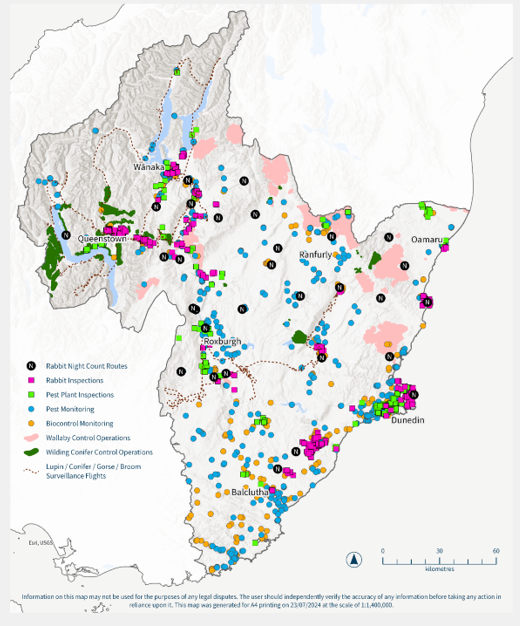
Geographical distribution of biosecurity pest inspections and monitoring activities throughout Otago. IMAGE: Supplied
“During the year, a secondary data collection tool was developed to monitor pests in non-property locations, such as road verges and river margins. This data collection tool also allows monitoring of pests outside of our compliance process. This includes pests such as rooks, spiny broom and organisms of interest.”
This allows the biosecurity team to gather information around distribution of biosecurity issues across the region.
Libby said a highlight of the year was engagement with landowners, the community, Crown agencies and territorial authorities.
There were a total 53 engagements with key Crown agencies and territorial authorities around various aspects of pest management, including Ministry for Primary Industries, Department of Conservation, Land Information New Zealand, KiwiRail, NZ Transport Agency I Waka Kotahi and the district councils of Waitaki, Dunedin, Clutha, Central Otago and Queenstown Lakes.
There were 767 engagements during summer through the Otago Regional Council's annual “Check, Clean, Dry” campaign to advocate and educate the public on preventing the transmission on water craft and gear of aquatic weeds, focusing on aquatic pest plants, including lagarosiphon.
“We got some resounding positive feedback to all the engagements,” Libby said.
There were 27 collaborations with neighbouring regional councils on pest management, including meetings, information sharing, site visits and staff exchanges, plus a further 32 meetings or visits with Environment Canterbury on wallabies.
There were 14 collaborations with Kāi Tahu on biosecurity issues.
There were 14 community events attended to support best practice pest control, and 61 advocacy and education engagements, including online, were circulated to the public.