‘Deck chairs on the Titanic’: Local leaders react to ORC disestablishment

Kim Bowden
02 December 2025, 5:00 PM
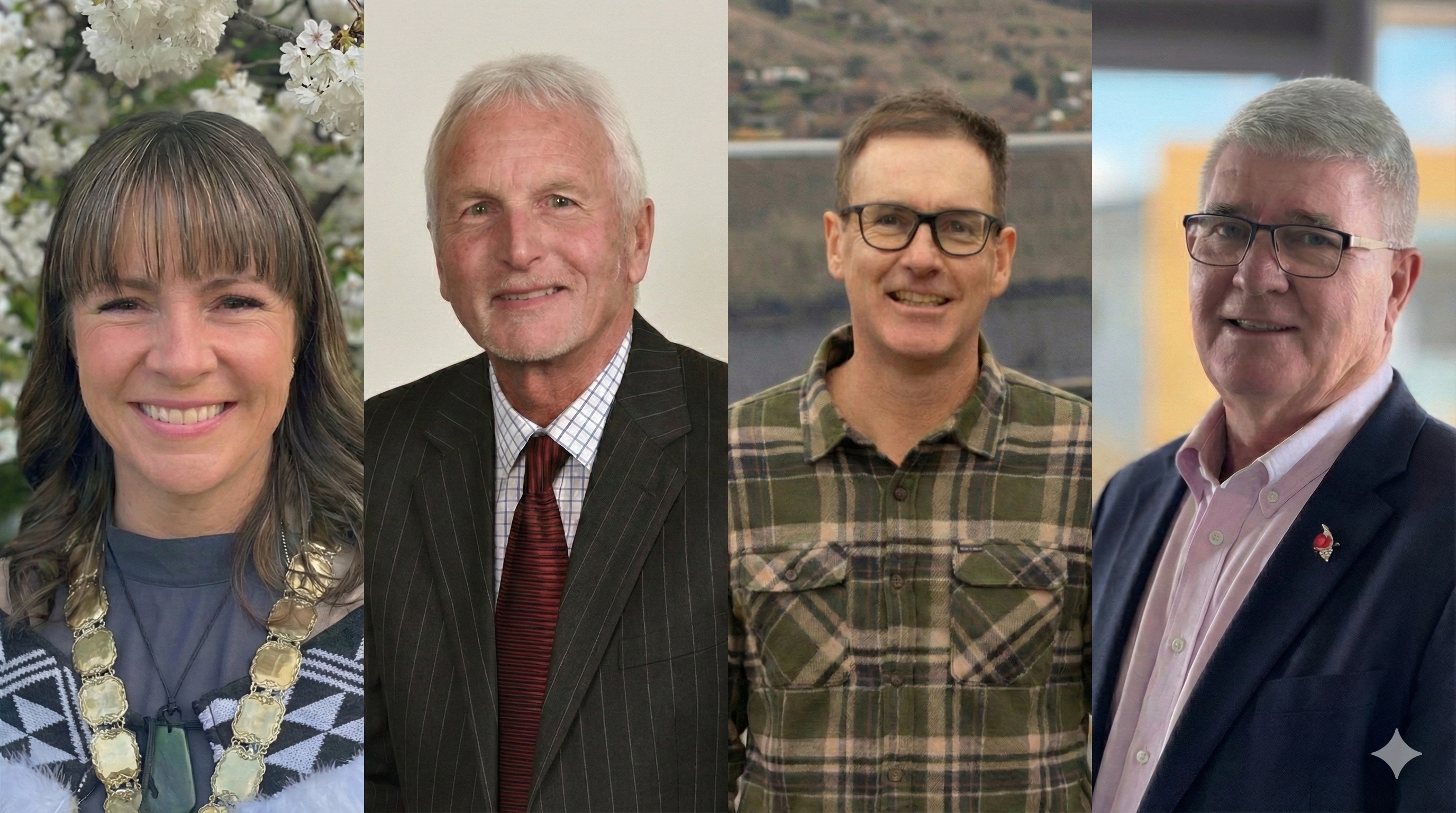 Central Otago mayor Tamah Alley and Otago regional councillors Michael Laws, Matt Hollyer and Neil Gillespie. Image: Gemini AI using file photos
Central Otago’s voice risks being drowned out by larger cities under a massive government shake-up that proposes scrapping the Otago Regional Council (ORC).
The government last week announced a controversial two-stage proposal to overhaul the sector.
Proposal one would see elected regional councillors stripped of their roles, replaced by ‘Combined Territories Boards’ made up of the region's local mayors.
Proposal two sets a strict deadline for the new boards: within two years, they must design a 'regional reorganisation plan' - essentially forcing local leaders to come up with a permanent new structure, such as the unitary authority models seen in Tasman or Marlborough.
Under the mayoral board, voting power would be weighted by population - a move Central Otago mayor Tamah Alley feared could sideline smaller regional communities.
"If votes are based solely on population, there’s a real risk that smaller districts like Central Otago are consistently outvoted by larger centres," Tamah told The Central App.
"We need a model that balances population with geography and communities of interest, so that inland and rural communities still have a meaningful voice.
“Population size can’t be the only factor when decisions are being made about our rivers, our infrastructure, and our future growth."
The move comes after sustained political criticism of the ORC.
Regional Development Minister Shane Jones has been one of the proposal’s strongest backers, previously describing the ORC as "the Kremlin of the South Island" in relation to a dispute over gold mining expansion.
He argued the current structure stifles growth, telling media he believed the council had been captured by "green banshees" who wanted to block development.
While fellow government ministers Chris Bishop and Simon Watts pitched the reform as a way to cut "tangled" duplication and save money, the district mayor remained cautious.
Tamah warned the move could simply shift the cost from one level of local government to another.
"At the moment, it’s far from clear what the financial impact on ratepayers would be once all the new structures, staff, and transition costs are added up,” she said.
“I’m concerned about our district ratepayers being left to carry the full cost of this reform.
“Any changes need to be genuinely more efficient.”
She also questioned whether mayors could absorb the massive portfolio of regional council work – public transport, flood protection and environmental management are all included in its remit – noting her weeks were “already very full”.
Newly elected regional councillor Neil Gillespie – a former deputy mayor of Central Otago for 15 years – said assessment by the Beehive the local government system was "tangled in duplication" and “confusing” reflected what many in the sector had already been saying.
But he was sceptical handing the reins to mayors - even temporarily - was the right fix.
"I'm not convinced that mayors, as they are currently constituted, are necessarily going to be able to better govern the regional council functions...those functions are very different to those of a district council," he said.
However, he argued the region shouldn't get hung up on the interim step of losing regional councillors, but focus on proposal two: the mandate to design a new, permanent model.
"The second proposal seems to be saying to local government that it should go away and come up with a structure that reflects unitary authorities…where the functions of district and regional councils are combined," he said.
"The clear message is that there will be change…These two proposals now provide an opportunity for a new structure that is fit for purpose.”
Meanwhile fellow Dunstan councillor Michael Laws described the interim step of a mayoral board as "clunky", arguing the government should have moved immediately to a unitary authority model rather than creating a temporary board.
"Replacing elected ORC councillors with elected mayors won’t make anything better. Like arranging the deck chairs on the Titanic," he said.
"The dead hand of Dunedin and 370 ORC staff will still be there implementing the same over-bureaucratic policy.
“Rates won’t decline with this model.”
A third Dunstan councillor, Matt Hollyer, questioned the logic of the timing.
With major Resource Management Act (RMA) reforms still weeks away, as signalled by the minister, he argued the cart was being put before the horse.
“Those reforms are going to play a huge role in the functions of all councils, they should have been announced in advance...so that there is a clearer understanding of the obligations and duties the councils are likely to be faced with delivering,” he said.
A newly elected councillor, Matt joked he'd “only been in the role for one month so it suggests my political career might be quite short”.
While he indicated a willingness to step aside if it served the community, he described the uncertainty as “upsetting and stressful” for council staff.
Turning to the substance of the proposal, Matt rejected the premise the current model was broken.
He questioned how mayors, already juggling their own district workloads, could dedicate suitable time to complex environmental issues.
"I am concerned that environment and catchment level interests will lose their priorities," he said.
He also took aim at the process, warning imposing the boards without a public vote crossed a line.
"If the government pushes through with the proposed timeline to make these Combined Territories Boards come into effect without a local body election then I believe the government is acting undemocratically."
From the Beehive, RMA Reform Minister Chris Bishop described the reform as “a once-in-a-generation chance to build a simpler, clearer, and more efficient local government system for New Zealanders”.
He described the current system as "confusing" and disconnected from the public.
"Most people know their mayor. Few could name the chair of their regional council," he said in a statement last week.
The government argued the new Combined Territories Boards would streamline decision-making.
For resource management specifically, they proposed a "dual threshold" vote, requiring both a majority of population-weighted votes and a majority of board members, as a safeguard for rural interests.
Consultation on the proposal is open until Friday, February 20.
NEWS