Cultural design unveiled at Cromwell facility

Staff Reporter
22 December 2025, 4:31 PM
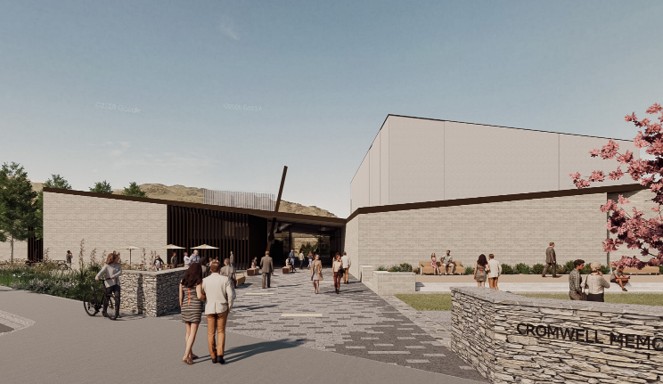 An artist’s impression shows the main entrance to the new lakeside facility in Cromwell, featuring a cultural interpretation of Rākaihautū’s kō. Photo: CODC
Cultural narratives are taking shape at Cromwell’s new lakeside community facility, with mana whenua design elements now visible following the removal of scaffolding from the building on the banks of the Kawarau River.
A prominent angled pole beside the main entrance has drawn attention, representing Tūwhakarōria, the giant kō or digging stick of Rākaihautū, a Kāi Tahu–Waitaha tipuna, chief and captain of the ancient Uruao waka, credited with shaping Te Waipounamu.
According to tradition, Rākaihautū used his kō to carve out the inland lakes and rivers of the South Island, with the displaced earth forming the surrounding mountain ranges.
The lakes were foretold as places of abundance, freezing glacial waters, and later, waterways shaped by people, known as he puna karikari.
The new hall and events centre sits near rivers feeding into Lake Dunstan, one of those man-made waterways created by the Clyde Dam on the Clutha/Mata-Au.
These waterways are poetically referred to as Kā Puna Karikari o Rākaihautū, the springs dug by Rākaihautū’s hand.
The kō is a central cultural feature developed from narratives provided by mana whenua and integrated into the building’s design by mana whenua-owned design team Aukaha – Mana Ahurea.
At a presentation to the Cromwell Community Board on Tuesday November 25, Paulette Tamati-Elliffe, of Te Rūnanga o Ōtākou, outlined the values behind the cultural design integration.
“When we look inland to the beautiful landscape, the great lakes, the stunning mountain ranges, where the water flows from into those rivers, we are reminded that Central Otago is the cradle of our creation narratives. Those mountains and waters are our ancestors. Our whakapapa connects us to these places,” Ms Tamati-Elliffe said.
“In the cultural design integration of the Cromwell facility, we wanted to bring the first people of this whenua to the visual realm. They are the descendants of Te Kāhui Waitaha, the earliest people of this land and descendants of Rākaihautū and many of the names of those descendants are embedded in the landscapes in Central Otago to this day.”
Aukaha – Mana Ahurea design lead Aroha Novak said the significance of the narrative required specialist expertise, leading to the involvement of Kāi Tahu artists Fayne Robinson and Andre Te Hira.
“For instance, the kō, Tūwhakarōria, pierces through the ceiling of the entrance way to the Events Centre and will be a beacon of light – literally. It will be illuminated at the centre as a wayfinding signal,” Ms Novak said.
“It’s a statement of mana and it has been such a privilege working with mana whenua, Central Otago District Council, Jasmax and SA Studio to embed this important narrative into the design integration of the building.”
Cromwell Community Board chair Anna Harrison said the cultural narrative flowed throughout the building and reflected the stories that shaped Cromwell and the wider Central Otago region.
“This building design really is so unique to Central Otago and carries such a significant narrative. It will bring so much value to Cromwell and the wider Central Otago region. I hope the community feels really proud of this.”
The facility has so far carried the working title Cromwell Memorial Hall and Events Centre, with a formal name yet to be confirmed.
Central Otago Mayor Tamah Alley said the council’s Open Spaces Naming Policy would guide the process.
“Our Open Spaces Naming Policy gives clear guidance for naming in both English and Te Reo Māori. It’s about more than names—it’s about partnership. The policy emphasises engagement with mana whenua, supports Te Reo names, and encourages dual naming so we can honour our cultural heritage while being practical.”
"Across New Zealand, we see great examples of this approach—Te Pae Christchurch Convention Centre, Tākina Wellington Convention and Exhibition Centre, and Toitū Otago Settlers Museum. These show how names can reflect identity and history while serving the community."
"We’ll start this conversation with a workshop on 4 February ahead of the Cromwell Community Board meeting. That will kick off consultation through March, with anticipation an English name recommendation going to Council in April.”
To find out more about the project go to:
Cromwell Memorial Hall & Events Centre | Let’s Talk Central Otago.
or click here
NEWS